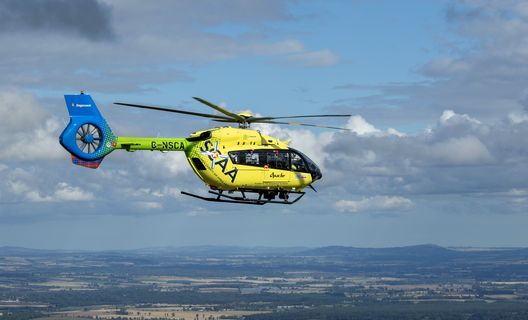
Scotland’s Charity Air Ambulance plays a vital role in Scotland and has to cover some very challenging terrain to reach patients when they need help quickly.
Unlike commercial passenger aircraft, air ambulance helicopters do not normally fly at one fixed altitude. Their height depends on the mission, weather, terrain, airspace, traffic and the need to reach the patient quickly. In mountainous or remote parts of Scotland, helicopters may fly relatively low so that the crew can remain in visual contact with terrain and identify suitable landing locations.
During an emergency response, the helicopter may descend as low as 500 feet when approaching an accident in order to identify a safe landing site. Helicopter Emergency Medical Service (HEMS) operations have specific aviation rules that allow helicopters to operate under different minimum-height requirements when necessary for their medical role.

When travelling between locations however, an air ambulance helicopter can climb considerably higher, up to 8,000 ft in our case. A greater altitude can sometimes provide a smoother and more time-efficient flight over long distances by allowing the pilot to steer a straighter course in cloud. Even then, the pilot must consider Scotland's mountainous terrain below, local weather, turbulence risk and the freezing level along the particular route.
Weather is especially important in Scotland. Fog, low cloud, strong winds and poor visibility can affect the altitude at which a helicopter can safely operate. A single mission can contain between 2 and 5 individual flights (known as sectors) dependent on range and patient location. Each sector may attract a different height profile dependent on the need of the crew to see the ground. For example, to find a patient at a remote location the crew will fly low in visual contact with terrain, but to return home to our Aberdeen base the crew may elect to fly high and descend using an instrument approach, only gaining sight of the runway just below 300 feet, at the very end of the trip.
This flexibility is particularly valuable in Scotland. SCAA transport patients from rural and island communities and supports specialist medical retrieval teams, allowing medical care to reach areas where road transport would be slower or impractical.

While air ambulance helicopters can fly at several thousand feet when conditions and the route allow, there is no single standard altitude. Their flying height changes constantly according to the mission, terrain and weather, but it’s always strictly governed by the rules set by the Civil Aviation Authority (CAA).
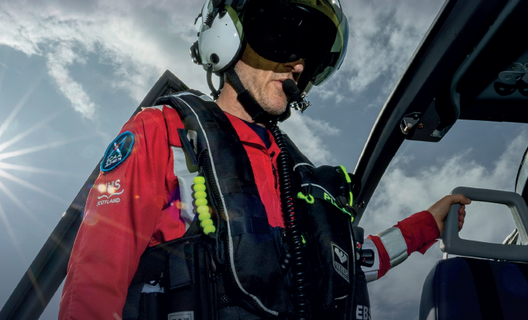
Thanks to your support, our expert crews consider all these factors when planning and flying a mission. There are many important factors that mean no two taskings are ever the same, but our mission to always get there in time remains constant.